Free BMR Calculator
What is your BMR (basal metabolic rate)?
Your BMR is the calories your body burns at complete rest, just to keep you alive. Get yours with the Mifflin-St Jeor formula, then add your activity to see your TDEE and calorie targets. Calculated, not estimated. Free, no account. Takes 30 seconds.
Your details
Watch: 15 seconds
Your BMR, explained.
Inside easyChef Pro
Your BMR is the baseline. The app turns it into a kitchen that runs itself.
The number you just calculated becomes the foundation easyChef Pro uses to set your TDEE, score every recipe, plan every week, and build every grocery list. Every meal is measured against your specific calorie and macro targets in real time.
Calculators Built In
BMR, TDEE, daily reference intakes (DRI), and macros, all inside the app and recalculated as your weight, activity, and goals change. Based on the Mifflin-St Jeor equation, USDA 2025-2030 guidelines, and NIH reference intakes. Set your number once and every meal is measured against it.
Recalculated as you changeParameters Per Recipe Score
Every recipe scored at the ingredient level using 800,000+ USDA-verified products. Calories, protein, net carbs, fiber, fat, glycemic impact, processing level, and more, calculated from real data, not estimates. So you can see if a meal fits your targets before you cook it.
Deterministic, not probabilisticSwap That Moves the Score Most
Every scored recipe shows the one ingredient swap that most improves it for your goal. Building muscle to raise your BMR? It shows the swap that raises protein density most. Cutting? It shows the swap that lowers calories most. Specific and different for every recipe.
One swap. Every recipe.A BMR of 1,500 becomes a TDEE of 2,325
Set your baseline and the whole system builds up from it.
Say your BMR is 1,500 and you are moderately active. Your TDEE is about 2,325, and if you want to lose a pound a week your target drops to 1,825. Every recipe in your meal plan filters to meals that fit, your grocery list rebuilds around them, and your health scores recalculate. You set one number. The system reconfigured everything else.
Inside easyChef Pro
See exactly how a recipe fits your day.
Paste any recipe link. Get a 0-100 score with the full breakdown at the ingredient level: calories, protein, carbs, fat, and fiber against your target. Free. No account required.
Traffic light breakdown
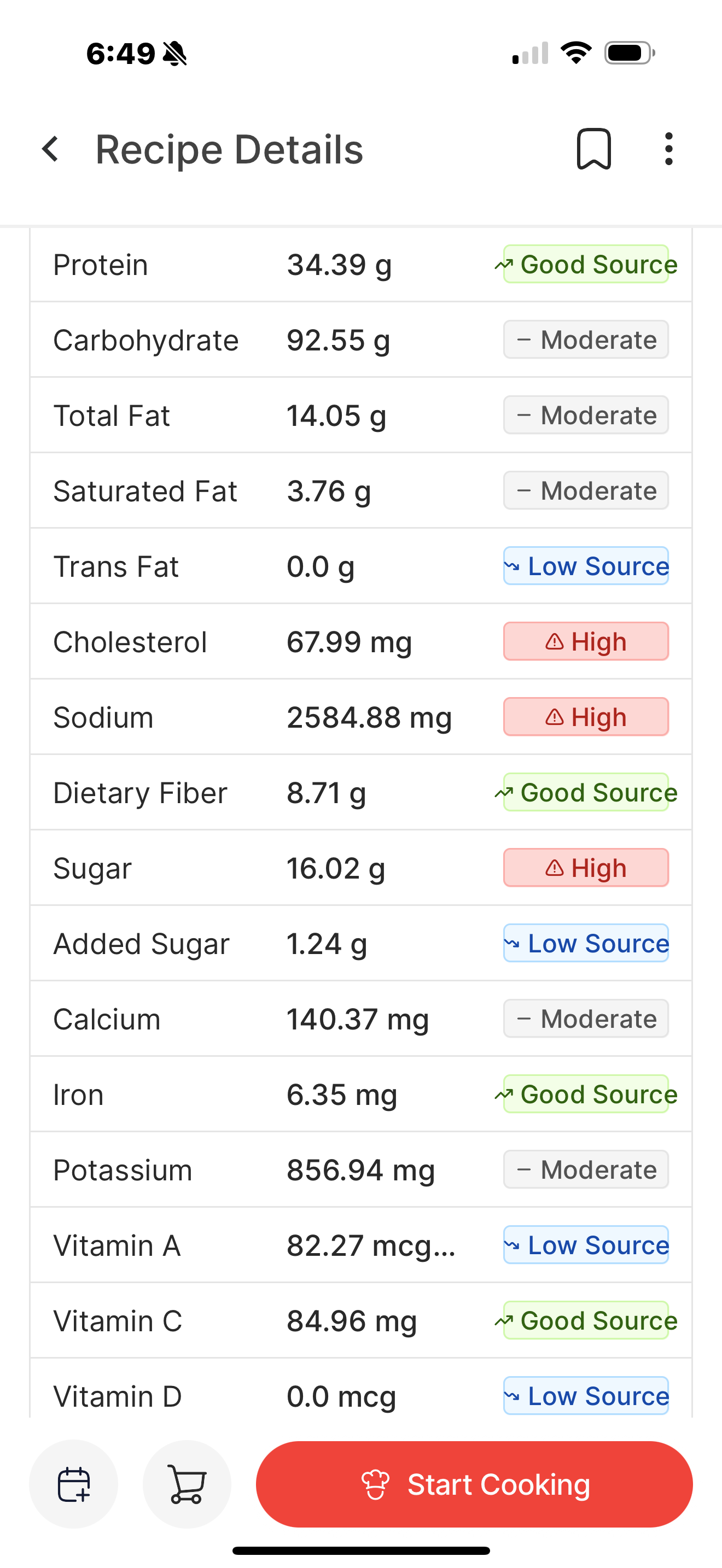
Calories and every macro labeled green, yellow, or red against your daily target.
Core nutrition scores
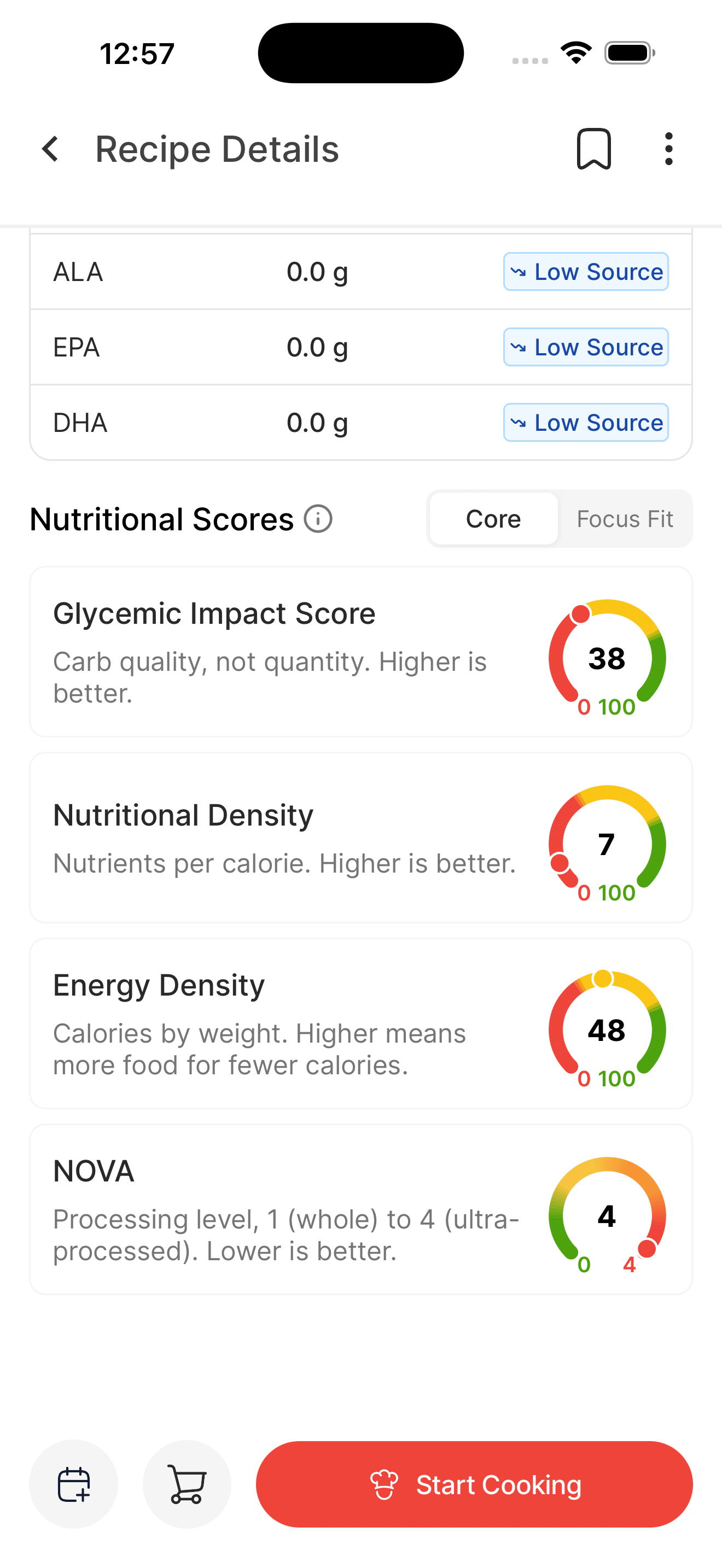
Glycemic impact, nutrient density, energy density, and NOVA processing. Four scores in one view.
Focus Fit scores
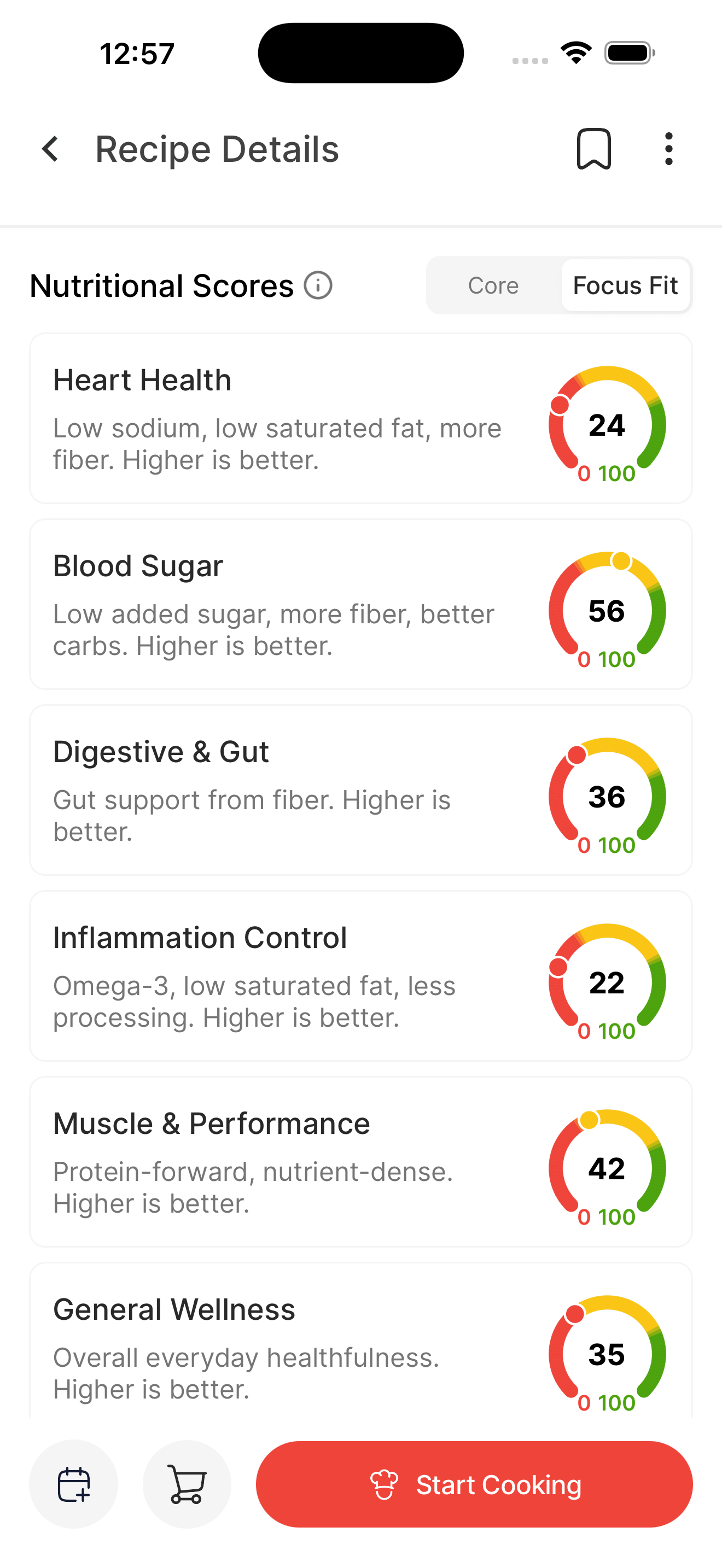
Six health dimensions. Your goal changes how every recipe scores against your targets.
Automatic calorie tracking
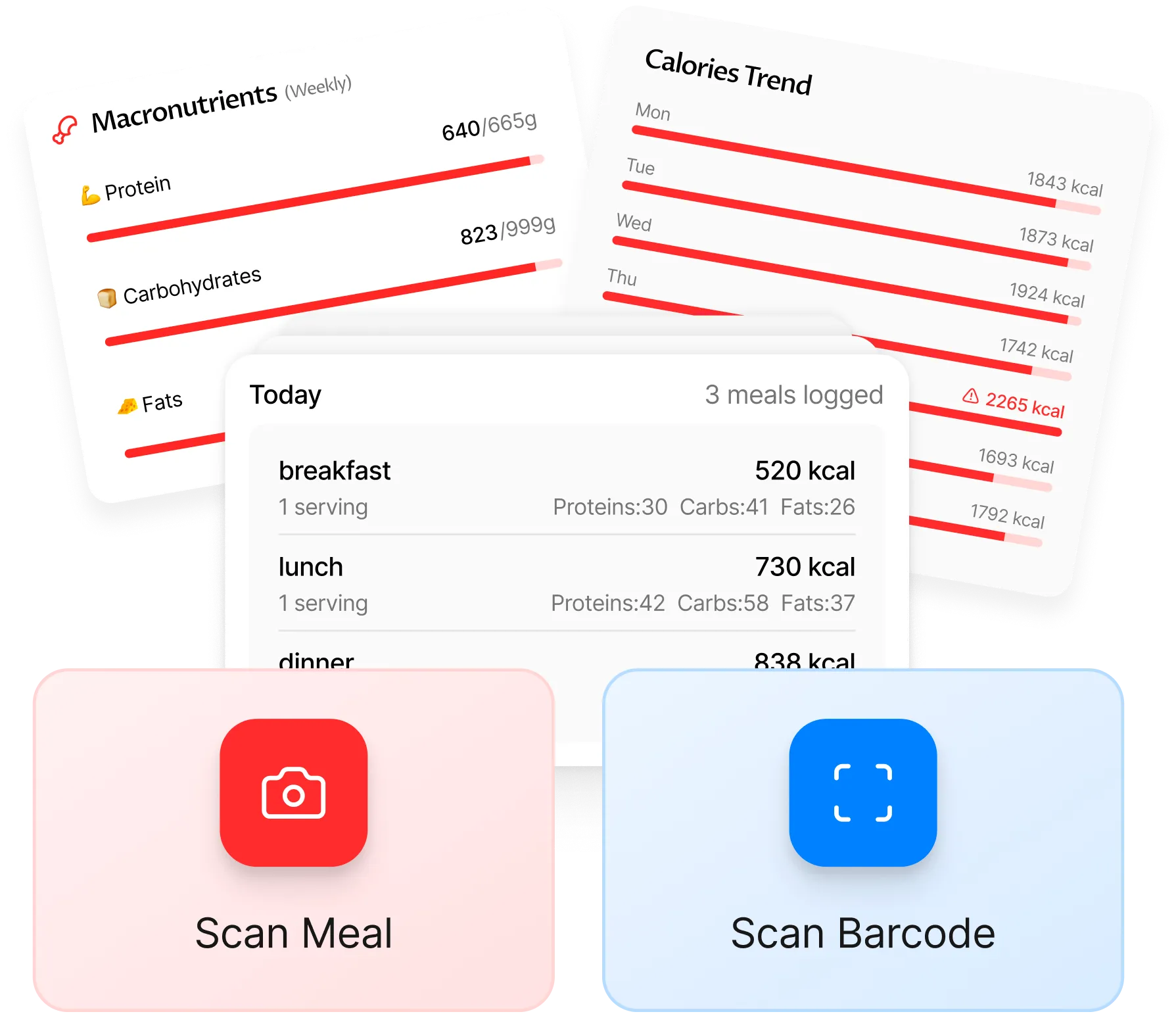
Track every calorie against your target.Without logging a single thing manually.
Every recipe you cook in easyChef Pro logs to your nutrition history automatically. Once your BMR sets your TDEE, track daily calories against your target, see weekly trends, and see exactly which meals keep you on track, without entering anything by hand.
Recipe calorie breakdown
See exactly how a recipe fits your numbers.Before you shop. Before you cook.
Paste any recipe URL into the easyChef Pro scorer. Get the full breakdown: calories, protein, carbs, fat, and fiber per serving, calculated at the ingredient level from USDA-verified data. Not an estimate. The actual number, measured against the target your BMR set.

What is BMR (basal metabolic rate)?
BMR (Basal Metabolic Rate) is the number of calories your body burns at complete rest, just to stay alive: breathing, circulation, brain and organ function. It is the largest single piece of your daily calorie burn, usually 60 to 70 percent, and it is the floor you never go below. Everything you do on top - walking, exercise, even digesting food - adds more.
How BMR is calculated: the Mifflin-St Jeor formula
The most accurate standard method is the Mifflin-St Jeor equation, validated against indirect calorimetry. It uses your weight, height, age, and sex: BMR = 10 x weight(kg) + 6.25 x height(cm) - 5 x age, then +5 for men or -161 for women. The calculator above converts your pounds and feet/inches and applies the formula, so you get your BMR without touching the math.
BMR for women vs men
The Mifflin-St Jeor formula adjusts for sex directly: at the same weight, height, and age, men get a higher BMR than women (the +5 vs -161 term), mostly reflecting differences in average lean mass. That is why a BMR calculator for women and one for men are really the same formula with a different constant, and the calculator here handles both correctly.
How to increase your BMR
The biggest lever is muscle: lean tissue burns more at rest than fat, so resistance training plus enough protein raises your BMR over time. Just as important, do not sit in a deep deficit for months - very aggressive dieting can lower your BMR as your body adapts. Adequate protein, sleep, and hydration all help keep your resting burn where it should be.
BMR vs TDEE
These get mixed up constantly. BMR is what you burn at complete rest. TDEE is your BMR plus all your movement, exercise, and digestion - always the larger number. You get TDEE by multiplying BMR by an activity factor (1.2 to 1.9), and you eat to your TDEE, not your BMR, to maintain weight. Your BMR is step one; your TDEE and your calorie deficit are built from it.
More free tools and reading
- TDEE Calculator: your total daily burn (BMR plus activity)
- Calorie Deficit Calculator: how many calories to lose weight
- Macro Calculator: protein, carbs, and fat targets
- Daily Nutrition (DRI) Calculator
- How to Track Calories Accurately: The Complete Guide
- Why Calorie Apps Give Different Numbers for the Same Food
Frequently asked questions
What is BMR (basal metabolic rate)?
BMR stands for Basal Metabolic Rate: the number of calories your body burns at complete rest, just to keep you alive. That covers breathing, circulation, brain function, and keeping your organs and cells running. It is the single largest part of the calories you burn each day, usually 60 to 70 percent of the total, before you move at all.
What is my BMR?
Your BMR depends on your weight, height, age, and sex, so there is no one number that fits everyone. Enter your details in the calculator above and you will get your exact BMR in seconds, calculated with the Mifflin-St Jeor formula. As a rough guide, many adults have a BMR between 1,300 and 1,900 calories per day.
What does BMR stand for and what does it mean?
BMR stands for Basal Metabolic Rate. It means the baseline energy your body uses at total rest to stay alive, measured in calories per day. It is the floor of your daily calorie burn: you never burn fewer calories than your BMR, and everything you do on top of it - walking, working, exercising, even digesting - adds more.
How is BMR calculated?
The most accurate standard method is the Mifflin-St Jeor equation. For men: BMR = 10 x weight(kg) + 6.25 x height(cm) - 5 x age + 5. For women: the same, minus 161 instead of plus 5. The calculator above converts your pounds and feet/inches for you and applies the formula, so you get your BMR without doing the math.
How can I increase my BMR?
The biggest lever is muscle: lean tissue burns more calories at rest than fat, so resistance training and enough protein raise your BMR over time. Staying well-fed also matters - very aggressive, long-term dieting can lower your BMR as your body adapts. Sleep, hydration, and not sitting in a deep deficit for months all help keep your resting burn where it should be.
What is BMR in nutrition?
In nutrition, your BMR is the starting point for every calorie plan. You multiply it by an activity factor to get your TDEE (total daily calories burned), and then set your intake relative to that: at TDEE to maintain, below it to lose, above it to gain. Knowing your BMR is step one; it is the number everything else is built on.
What is the difference between BMR and TDEE?
BMR is what you burn at complete rest. TDEE (Total Daily Energy Expenditure) is your BMR plus everything else you do in a day: movement, exercise, and digestion. TDEE is always higher. You get TDEE by multiplying your BMR by an activity factor (1.2 for sedentary up to 1.9 for very active). You eat to your TDEE to maintain weight, not your BMR.